
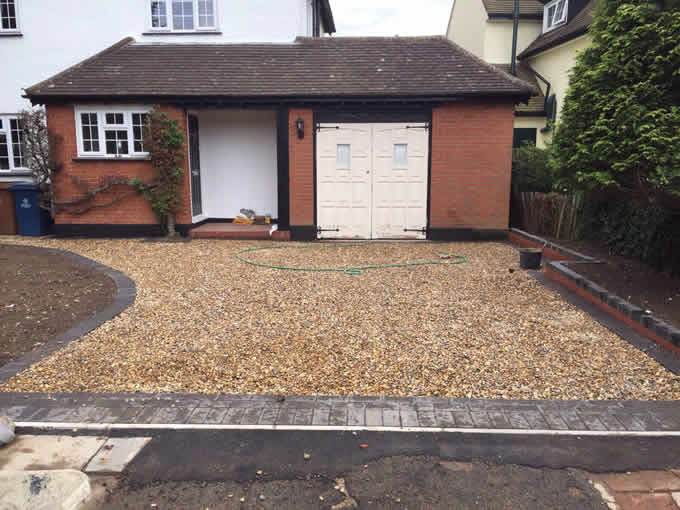
Gravel driveways are popular around Plymouth because they’re affordable, look smart, and (done right) they drain well. But when we get a proper downpour, a gravel drive can quickly turn into ruts, potholes, and piles of stone at the bottom of the slope.
The good news: most “rain damage” comes down to a few common issues (shape, base, drainage, and the wrong type of gravel). Fix those, and a gravel driveway can cope with heavy rain year after year.
This guide explains what actually happens in bad weather and the practical ways to fix it properly.
What heavy rain does to a gravel driveway
1) It washes the fine material out first
Gravel driveways need a mix: larger stones plus smaller “fines” that lock everything together. During heavy rain, water can carry those fines downhill, leaving loose stone behind. That’s when the surface starts to feel like you’re walking on marbles.
2) It creates ruts and potholes
When water sits on the surface (or runs in channels), tyres push the loose stone aside and the base softens. Over time, this forms ruts and potholes. Road maintenance guidance explains the principle clearly: if water doesn’t drain away, ruts and potholes follow.
3) Gravel migrates to the edges or straight into the road
If the driveway has no edging or the surface is too loose, heavy rain and tyre action will push gravel to the sides and into drains, pavements, or the highway. That’s messy, can block drainage, and can be a slip risk.
4) The driveway can “sink” in soft spots
Where the ground below is clay-heavy or poorly prepared, water saturates the sub-base and the gravel slowly presses into the soil. You’ll notice this as low spots that stay wet longer than the rest.
5) It exposes weak drainage (and causes flooding where you don’t want it)
A gravel driveway is often used because it’s permeable, but permeability alone doesn’t solve everything. If your driveway slopes towards the house/garage, or the water has nowhere to go at the bottom, you can still get pooling and run-off issues.
Why it happens (the real causes)
In most Plymouth jobs, the root cause is one (or a combination) of these:Quick checks after heavy rain (5 minutes that saves you money)
- Where is the water flowing? Walk the driveway in the rain (or right after) and look for channels.
- Where is it pooling? Low spots = future potholes.
- Are drains and gullies blocked with gravel? Clear them quickly.
- Is gravel spilling onto the pavement/road? That often signals no edging or poor shaping.
- Are ruts forming in the same tracks? That often means the crown/fall is wrong.
How to fix a gravel driveway after heavy rain
Fix 1: Re-grade and restore the crown (the biggest win) If your driveway is flat or “dished”, water will sit and damage it. The most effective fix is reshaping the surface so it sheds water to the sides (or to a defined drainage route). Guidance for gravel surfaces repeatedly points back to crown and cross-section as key inspection and maintenance items. DIY-friendly? Sometimes, for small drives and light damage. Best done professionally if the driveway is long, steep, or badly rutted. Fix 2: Add the right gravel blend (not just “more gravel”) Topping up with random bags often makes things worse because you’re adding loose stone without a binding layer. A more stable surface typically needs:- a supportive base layer (if missing), and
- a top layer with enough fines to lock in
- Small areas: a plate compactor can help.
- Larger driveways: professional compaction and correct layering makes a noticeable difference.
- timber sleepers (quick, budget-friendly)
- stone/kerb edging (neat and long-lasting)
- metal edging (minimal look for modern homes)
- a shallow swale (a gentle channel that guides water away)
- a French drain along one side
- a soakaway at the bottom
- a channel drain in front of a garage threshold (in some cases)
- Light rake every few weeks (more in winter)
- Top up low spots early (before they become potholes)
- Keep drains/gullies clear
- Re-grade annually if your driveway sees heavy use
DIY vs hiring a contractor: when is it worth paying a pro?
DIY is usually fine if:- It’s a small area (a few ruts/potholes)
- The driveway is mostly flat
- You can get materials delivered easily
- You can compact properly
- Your driveway is steep or long
- Water is flowing towards your house
- You need drainage added (French drain/soakaway/channel drain)
- The base is failing (sinking/soft spots)
- You want a “done once, done right” finish
Contractor checklist (quick but important)
Before you book anyone:- Get a written quote with a clear spec (grading, materials, drainage, edging)
- Ask how they’ll handle waste removal and check they’re properly registered (you can verify on the Environment Agency public register).
- Confirm what’s guaranteed and for how long