
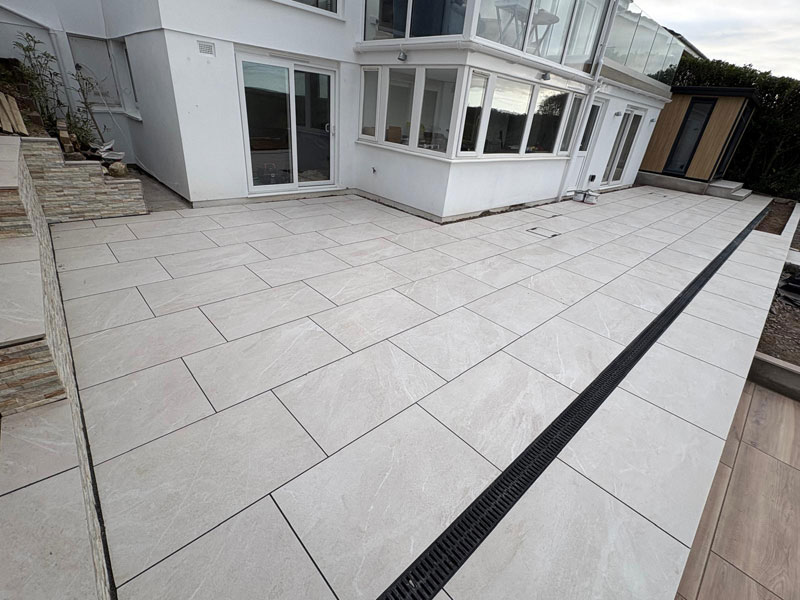
If you live in Devon, Cornwall, or around Plymouth, you already know our outdoor spaces get a proper test: long wet spells, salty coastal air, shady gardens that stay damp, and the odd freeze-thaw week that finds every weak spot.
That’s why the material choice matters just as much as the design.
In the South West, coastal rainfall is commonly around 900–1000 mm per year, and upland areas can see up to double that. That mix of damp + mild winters is perfect for algae and moss, and it’s exactly what exposes poor installation (wrong falls, weak jointing, thin bedding).
So, which holds up better: porcelain patio paving or Indian stone (typically Indian sandstone)?
The short answer
- Porcelain usually wins on low maintenance, stain resistance, and wet-weather performance if you choose outdoor-rated, slip-resistant tiles and install them correctly. Porcelain is classed as “porcelain” partly because it has very low water absorption (≤0.5%), which makes it highly frost resistant.
- Indian sandstone wins on natural character, repairability, and that classic “South West garden” look — but it generally needs more routine care (cleaning and often sealing) to stay looking its best in damp/shady spots.
Let’s break it down properly so you can choose with confidence.
Why South West weather is tough on patios
The biggest enemies of any patio here are:
- Constant moisture (more algae/moss; more staining risk)
- Shade (paving stays damp longer, encouraging growth)
- Freeze-thaw (water gets into tiny pores, freezes, expands, and can damage weaker materials over time)
Even the best slabs won’t “hold up” if the patio is laid flat, drains poorly, or joints fail. So think of this as material choice + correct build.
Porcelain patios in South West weather
What porcelain does well
1) Very low water absorption = strong frost resistance
Porcelain tiles are defined as fully vitrified and typically have ≤0.5% water absorption. That low absorption is a big reason they’re considered frost-proof and well suited to outdoor use.
2) Low maintenance in damp gardens
Because porcelain is non-porous compared with most natural stones, it’s generally less prone to deep organic staining. It still gets surface grime like anything outside, but it often cleans up quickly.
3) Slip resistance options are clearer and more consistent
Many UK ranges are sold specifically as outdoor porcelain with R11 slip resistance, suitable for wet conditions.
(Just don’t accidentally buy an indoor glossy tile for outdoors.)
The weak points of porcelain
1) Installation needs to be “by the book”
Porcelain is less forgiving. If it’s not laid on a full, solid bed with the right primer/slurry and correct jointing, you can get drummy tiles, rocking corners, or water getting where it shouldn’t. The tile itself may be strong, but poor installation causes failures.
2) Chips can show more than on riven stone
A dropped cast-iron chiminea base or a sharp metal edge can chip porcelain. It’s not fragile, but chips are more noticeable on a clean, uniform finish.
3) Wrong finish = slippery
Outdoor porcelain is usually textured for grip, but always confirm the slip rating (R11 is commonly used for external).
Indian stone patios (Indian sandstone) in South West weather
What Indian stone does well
1) Natural grip and character
Riven sandstone has texture and variation, and it suits South West homes beautifully. It also tends to hide day-to-day marks better than a very uniform surface.
2) Easier to repair invisibly
If a slab gets damaged, stone’s natural variation can make replacements less obvious than a “perfect match” porcelain tile.
3) Comfortable underfoot and visually warmer
Many people simply prefer the feel and look of natural stone outdoors.
The weak points of Indian stone in our climate
1) It’s porous, so damp + shade can mean algae/moss
Maintenance guidance for sandstone notes there’s a tendency for algae, lichens and mosses to colonise paving that’s permanently shaded and/or damp.
2) Staining risk is higher without protection
Because stone has pores, organic staining (leaf tannins, BBQ grease, algae) can be more stubborn. Many suppliers/contractors recommend sealing to reduce staining and algae growth.
3) More “routine care” than porcelain
It’s not hard work, but it’s a real difference:
- regular sweeping
- occasional deeper cleaning (especially after winter)
- and potentially re-sealing every few years (many guides suggest 2–3 years depending on exposure and product).
Head-to-head comparison for Devon, Cornwall & Plymouth homes
| Factor | Porcelain patio | Indian stone (sandstone) patio |
| Rain + damp shade | Usually easier to keep clean | Can attract algae/moss faster in shade |
| Frost resistance | Excellent due to ≤0.5% absorption | Generally fine, but porosity varies; sealing helps reduce water ingress |
| Slip resistance | Choose outdoor R11+ products | Often good with riven finishes; still needs cleaning in damp areas |
| Stains (BBQ, leaves, pots) | Lower risk; cleans easier | Higher risk if unsealed; sealing helps |
| Look & “feel” | Modern, consistent | Natural variation; traditional South West look |
| Best for | Low-maintenance patios, busy families, rentals/holiday lets | Character gardens, cottage style, people happy to do light maintenance |
Real-life South West examples
Example 1: Coastal garden in Plymouth (salty air + wind + wet winters)
If you want a patio that stays smart with minimal effort, outdoor porcelain (R11) is usually the safer choice. The low absorption and easier cleaning are big wins when everything outside gets grimy faster.
Example 2: Shady Devon garden under trees (leaves + damp corners)
Indian sandstone can still work brilliantly — but expect you’ll need a simple routine: sweep leaf mulch quickly, clean seasonally, and consider sealing to reduce algae and staining.
If you’d rather avoid that, porcelain is the lower-maintenance option.
Example 3: Cottage-style Cornwall home (you want that natural look)
Indian stone is hard to beat visually. Just plan for periodic cleaning and protection so it doesn’t turn green in the shady spots.
The “holds up better” factor people forget: installation
In South West weather, these installation details matter more than the slab choice:
- Correct falls (so water runs off, not sits)
- Proper sub-base (stable, well compacted)
- Full bedding (no voids where water can sit)
- Good jointing (so joints don’t fail and invite weeds/washout)
Get those right and both materials perform well. Get them wrong and both will disappoint — porcelain just tends to show problems sooner because it’s less forgiving.
So, which should you choose?
Choose porcelain if you want:
- a cleaner, modern look
- the lowest maintenance option
- strong wet-weather performance (with the right slip rating)
- excellent frost resistance due to very low absorption
Choose Indian sandstone if you want:
- a warmer, natural look that suits South West homes
- a patio that “ages naturally” with character
- you’re happy to do light maintenance and likely sealing in damp/shady areas
Local help across Plymouth, Devon & Cornwall
If you’re still unsure, it often comes down to where the patio sits (full sun vs shade), how you use it (kids, pets, BBQs), and how much maintenance you want to do.
Stone Cross Paving Ltd works across Plymouth, Devon and Cornwall on patios, paving and wider exterior upgrades, and they note 5-year guaranteed work on their site. (Stone Cross Paving Ltd)