
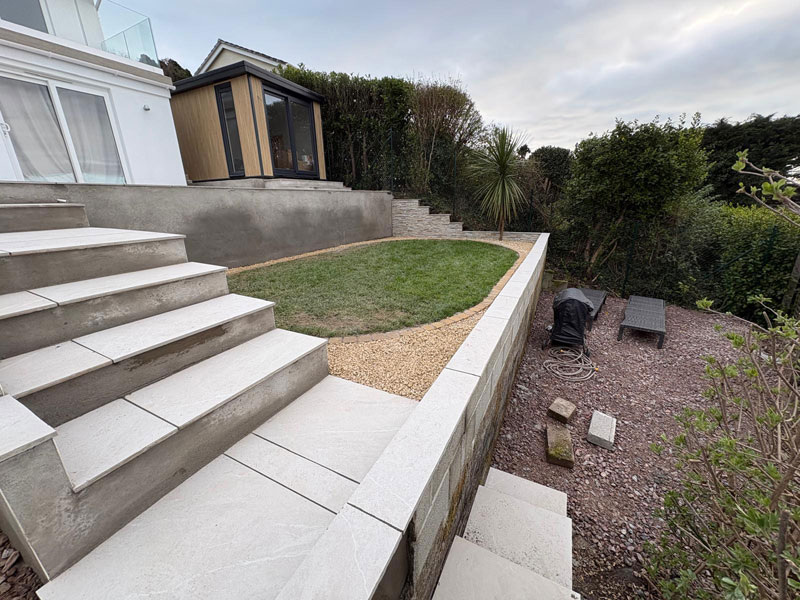
Plymouth has no shortage of gardens that sit on some kind of slope, whether that’s a gentle rise at the back of a terrace or a steeper drop across a larger plot. When it comes to marking a boundary or holding back a change in level, homeowners are often deciding between a garden wall and a fence, and the right answer depends on more than which one looks nicer.
The two do genuinely different jobs. A fence marks a boundary and provides privacy or screening. A garden wall can do that too, but it can also retain soil and hold back a level change, which a fence simply isn’t built to do. Getting this distinction right at the planning stage saves a lot of trouble later.
What’s the actual difference in function?
A standard timber or panel fence sits on top of the ground and relies on posts set into concrete for stability. It’s not designed to resist lateral pressure from soil behind it. If you try to use a fence to hold back a raised bed or a change in ground level, even a modest one, the posts will eventually lean or the panels will bow, because the fence was never built to act as a retaining structure.
A garden wall, when built properly with adequate footings and, where needed, drainage behind it, can hold back soil and manage a change in level in a way a fence can’t. That makes it the right choice anywhere there’s a genuine level difference to manage, not just a boundary to mark.
When a fence is the right call
If the ground on both sides of the boundary is roughly level, or the slope runs along the boundary line rather than across it, a fence is usually the simpler and more cost-effective option. Fencing also makes sense where the priority is privacy or screening rather than managing soil, and where the garden doesn’t have a level change that needs retaining.
Panel fencing can be stepped down a slope in sections, which is a standard approach on sloping plots and doesn’t require the fence itself to resist any soil pressure.
When a garden wall is the right call
A garden wall becomes the practical choice wherever there’s a change in level that needs to be held back, for example where a patio or lawn sits higher than an adjoining path or driveway, or where a raised bed needs a permanent edge. It’s also a better long-term option in more exposed spots, since a well-built wall handles wind and weather with less maintenance than a fence over time.
On a genuinely steep slope, a garden wall combined with steps is often what actually makes a garden usable, turning an awkward incline into distinct, level areas.
What determines the right choice on your property
A few practical questions tend to settle it:
- Is there a level change to manage, or just a boundary to mark? If it’s purely a boundary on level ground, a fence is usually sufficient.
- How significant is the slope? A gentle rise might only need a low retaining kerb or edge, while a steeper drop calls for a properly engineered wall.
- What’s behind the boundary? A wall retaining soil next to a path, patio or driveway needs to be built to handle that load safely; this isn’t really a DIY job once any meaningful height is involved.
- What’s the budget and timeline? Garden walls generally cost more and take longer to build than fencing, given the groundwork, footings and materials involved.
Local considerations for Plymouth and the South West
Plymouth’s higher-than-average rainfall means any retaining structure, wall or otherwise, needs proper drainage behind it to avoid water building up and putting pressure on the structure over time. This applies whether the wall is brick, block, or natural stone. Coastal exposure in parts of Plymouth and along the Cornwall and Devon coastline is also worth factoring in, since salt-laden air and repeated wetting and drying can affect certain materials and mortars faster than they would inland.
For anything beyond a low retaining edge, it’s worth checking with your local council whether the height or position of a proposed wall needs planning permission or building control sign-off, since this can vary depending on the specifics of the site.
Practical takeaways
Before deciding between a wall and a fence, walk the boundary and look honestly at whether there’s a level change involved, not just at ground level but a metre or two either side. If soil, a patio, or a path sits noticeably higher on one side, that’s usually the deciding factor regardless of preference on appearance. It’s also worth thinking about what the space needs to do; privacy and screening point toward fencing, while managing a slope or creating usable level areas points toward a wall, sometimes with steps included.
When professional help makes sense
Any wall with a genuine retaining function, holding back soil at any meaningful height, needs proper footings and drainage to be safe and long-lasting, and this is worth having assessed by someone experienced in garden wall construction rather than approached as a straightforward DIY project. A fence on level ground is a much simpler undertaking, but on a sloping plot even fencing benefits from someone who can advise on stepping the panels correctly.
If you’re not sure whether your garden needs a wall, a fence, or a combination of the two, Stone Cross Paving can take a look at the site and talk through what would actually work for the slope you’ve got.